

Specify the wrong cooler and even a flagship processor turns into an expensive space heater that throttles the moment a sustained workload arrives. The debate between tower air coolers and all-in-one (AIO) liquid coolers has been running for more than a decade, yet the answer keeps shifting as CPUs grow hungrier and both technologies mature. This guide examines the engineering behind each approach, compares real thermal and acoustic behaviour, and lays out practical selection criteria for system builders, integrators and procurement teams.
The stakes are higher than they were five years ago. Modern desktop processors routinely draw 150 to 250 watts under all-core load, and their boost algorithms convert every spare degree of thermal headroom directly into clock speed. Cooling has stopped being a background accessory — it is now a performance component in its own right, and it deserves the same attention as the CPU it protects.
Two routes from the silicon die to room air
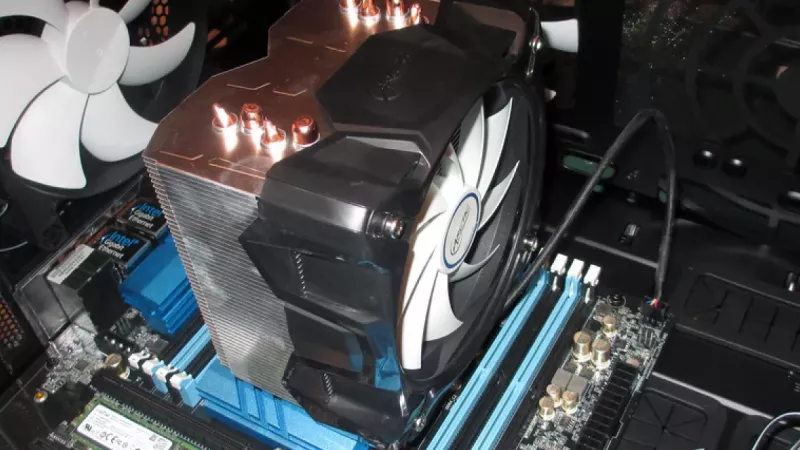
An air cooler moves heat through a short, entirely passive chain. Energy leaves the CPU heat spreader through a layer of thermal paste, enters a nickel-plated copper base, and is carried upward by heat pipes in which a small quantity of working fluid evaporates at the hot end and condenses at the cold end. An aluminium fin stack then hands the heat over to airflow produced by one or two fans. Per fan, there is exactly one moving part in the whole assembly — and nothing else that can wear out.
An AIO replaces the heat pipes with a sealed, factory-filled pumped loop. A microfin cold plate sits on the processor, a low-voltage centrifugal pump pushes coolant through reinforced tubing to a remote radiator — 120, 240, 280 or 360 mm long — where fans reject the heat, usually straight out of the chassis. The decisive architectural advantage is relocation: thermal energy is dumped at the case boundary rather than recirculated above the motherboard, where it would otherwise warm voltage regulators, memory modules and the graphics card.
Where air cooling still wins
- Mechanical simplicity. With no pump, no coolant and no permeable tubing, a quality tower cooler has no defined end of life. Replace a failed fan for a few euros and the heatsink itself carries on for another decade of service.
- Fail-safe behaviour. If the fan stalls, the fin stack continues dissipating a meaningful share of the load passively, giving the system time to raise an alarm and shut down gracefully instead of crashing within seconds.
- Cost efficiency. Euro for euro, a mid-range tower delivers more cooling capacity than an entry-level liquid unit, and premium dual-tower models rival 240 mm AIOs while costing noticeably less.
- Silent idling. With the fan spun down or stopped entirely, an air-cooled system is effectively inaudible; there is no pump to hum in the background of a quiet room.
What the pump actually buys you
- Raw sustained capacity. A 360 mm radiator offers considerably more dissipation surface than any fin tower that fits inside a standard chassis, which matters once package power passes the 200-watt mark.
- Zero clearance conflicts. The block on the socket stands only 45 to 55 mm tall, so tall memory heatspreaders, dense VRM cooling and narrow enclosures never become a problem.
- Heat exported from the enclosure. Mounted as exhaust, the radiator removes CPU heat before it can raise the internal ambient temperature that every other component must live with.
- Thermal inertia. Several hundred grams of coolant absorb short load spikes, smoothing fan ramps and keeping boost clocks steadier during bursty workloads such as compilation or video scrubbing.
Sustained load: where the curves converge
Ten-minute benchmarks flatter liquid cooling because the coolant is still soaking up heat. Run a rendering or compilation job for a full hour and the picture stabilises: on a 220-watt processor, a top-tier dual-tower air cooler typically lands within 4 to 8 °C of a 360 mm AIO. That margin can be the difference between full boost and mild throttling on a flagship chip, but on a 65 to 125-watt mid-range CPU it is close to irrelevant — both solutions hold the silicon comfortably inside specification.
The practical conclusion follows directly: match the cooler to sustained package power, not to the marketing tier of the processor brand. A modest chip under a giant radiator gains nothing measurable.
Acoustics: surface area sets the noise floor
Noise is a function of how hard fans must work per watt dissipated. Because a large radiator spreads the load across more area, its fans can turn slower for the same result, which is why a well-tuned 360 mm AIO is usually the quietest option under heavy load. At idle the ranking reverses: pump whine, however faint, gives the air cooler the edge in near-silent environments such as recording studios or open-plan offices. Radiator thickness, fin density and fan quality shift these curves far more than brand names do, so acoustic targets belong in the specification sheet, not as an afterthought.
Reliability, lifespan and failure modes
Pumps are typically rated between 50,000 and 70,000 hours MTBF, and permeation through tubing slowly reduces coolant volume over the years. In practice a sealed loop should be treated as a five-to-seven-year consumable. Catastrophic leaks are statistically rare, and premium vendors back their units with warranties that cover collateral component damage, but the risk is not zero and should be acknowledged in any deployment plan. Air coolers invert the risk profile entirely: the only wear item is a standardised fan, replaceable in minutes without even removing the heatsink.
For unattended or remote systems this asymmetry matters. A degrading fan announces itself through rising temperatures and RPM alarms long before outright failure; a dying pump can go from functional to critical within days, with far less warning.
Compatibility planning for volume builds
Air cooling requires three checks: heatsink height against the case specification, fin-stack overhang against memory height, and socket mounting hardware. Liquid cooling swaps those for radiator mounting points, tube reach and hose routing. When standardising a build list, verify that the chassis supports the radiator size in the intended position before committing to an AIO SKU. Reviewing the current range of CPU coolers side by side makes it easier to shortlist models that fit every chassis in a product line rather than qualifying each combination individually.
The variable everyone forgets: chassis airflow
Either technology collapses inside a poorly ventilated enclosure. An air cooler recirculates hot air unless intake and exhaust fans establish a clear front-to-back path; an AIO radiator loses effectiveness when it is fed pre-heated air from a graphics card. Budgeting for two or three quality case fans frequently yields a larger thermal improvement than stepping up a cooler tier, at a fraction of the cost.
Working rule: below roughly 120 watts of sustained package power, a mid-range tower cooler is the rational default. Between 120 and 200 watts, choose either a premium dual tower or a 240–280 mm AIO based on chassis fit and acoustic targets. Above 200 watts — or in short enclosures where towers simply do not fit — specify a 360 mm AIO.
Frequently asked questions
Does an AIO always outperform an air cooler?
No. A premium dual-tower unit routinely matches or beats 120 and 240 mm liquid coolers. The consistent liquid advantage only appears at 280 mm and above, and mainly on processors drawing over 150 watts for extended periods.
How long does a sealed loop realistically last?
Plan around five to seven years. Pump bearings wear, and a small annual percentage of coolant escapes through tubing permeation, gradually reducing capacity. Most branded units carry five or six-year warranties that align with exactly this window.
Can the coolant in an AIO be topped up?
Standard sealed units are not designed for user service, and opening them voids the warranty. A handful of enthusiast models expose a fill port, but for fleet purposes an AIO should be treated as a sealed, replaceable module rather than a maintainable loop.
Where should the radiator be mounted?
Top exhaust is the safest default, with the pump positioned lower than the highest point of the radiator so that any air pocket collects in the radiator instead of the pump chamber. Front intake improves CPU temperatures slightly but feeds warmed air to the graphics card, so it suits CPU-heavy workloads best.
Is a heavy tower cooler safe to ship in an assembled system?
A kilogram of metal cantilevered off the socket can crack a motherboard in transit. Professional integrators either fit transport braces or foam supports inside the chassis before shipping. AIO blocks weigh a fraction as much, which is one reason many system builders prefer them for pre-built shipments.
Leave a comment