

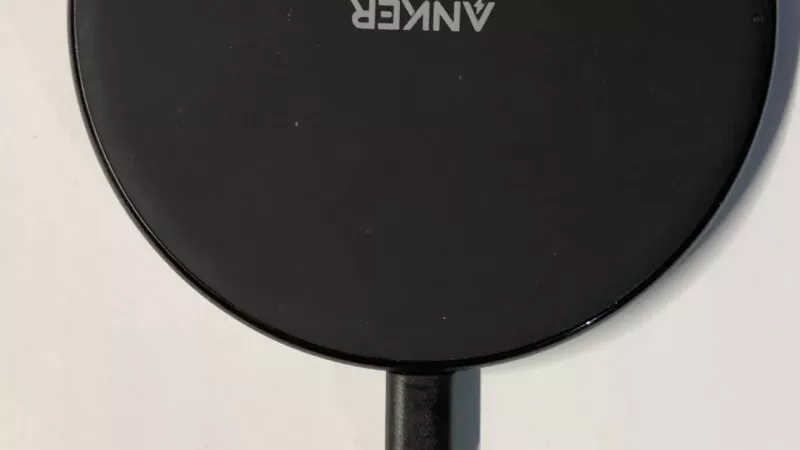
Ask ten people how a wireless charger works and most will say something like: you put the phone down and electricity happens. That answer skips over everything that actually shapes your experience — why one pad refills a battery in under two hours while another needs half the night, why a handset sometimes turns warm and quietly slows down, and why the arrival of Qi2 with its magnetic ring is the biggest step forward since the technology went mainstream. This guide unpacks the physics, the standards and the buying decisions in plain language.
Induction in plain terms
Inside every charging pad sits a transmitter coil; inside every compatible phone, a receiver coil hides beneath the back cover. When alternating current runs through the transmitter, it generates a rapidly oscillating magnetic field. That field induces a matching current in the receiver coil, which the phone converts into direct current and feeds to its battery. The exchange happens across an air gap of only a few millimetres, at operating frequencies of roughly 110 to 205 kHz.
Because energy crosses a magnetic field instead of a copper wire, losses are unavoidable. Cabled charging routinely converts over 90 percent of drawn power into stored energy; wireless systems typically land between 60 and 75 percent. Where a specific setup falls inside that range depends overwhelmingly on a single variable: how precisely the two coils sit on top of each other.
From Qi to Qi2: the short history that matters
The original Qi specification from the Wireless Power Consortium defined a Baseline Power Profile at 5 W and later an Extended Power Profile reaching 15 W. It worked, but it had two structural weaknesses. First, positioning was left entirely to the user, so real-world efficiency varied wildly from one placement to the next. Second, manufacturers layered proprietary fast modes on top, which only activated with matching hardware and confused buyers with headline wattages that rarely materialised.
Qi2, ratified in 2023, addresses both problems through the Magnetic Power Profile. Apple contributed the magnetic architecture behind its MagSafe ecosystem, so every certified Qi2 charger carries a ring of magnets that snaps the handset into the one position where coil coupling peaks. First-generation Qi2 delivers a certified 15 W, and the newer Qi2 25W revision raises the ceiling to 25 W on supported phones.
Magnets as an engineering decision
Magnetic docking is often marketed as convenience, but its real value is electrical. A perfectly centred coil pair wastes less energy as heat, sustains higher average power and behaves predictably with accessories such as car mounts, charging stands and stackable power banks. It also eliminates the classic overnight failure where a phone laid slightly off-centre shows the charging icon all night yet gains almost nothing by morning.
Decoding the wattage labels
A number printed on a charger describes peak transmitter output under ideal conditions, not a constant delivery rate. Actual power is negotiated continuously between pad and phone, then adjusted for temperature and battery level. The practical tiers look like this:
- 5 W: the universal floor. Fine for overnight bedside duty or topping up earbuds, but a large phone battery can take four hours or more.
- 7.5–10 W: the legacy middle ground that many older handsets negotiate on Extended Power Profile pads.
- 15 W: the certified Qi2 level. Expect a typical flagship to reach around 50 percent in half an hour and a full charge in roughly two hours.
- 25 W: the Qi2 25W tier, closing much of the gap to mid-range wired charging on the newest devices.
- 30 W and beyond: proprietary systems from individual brands. Impressive on paper, but the speeds appear only when the phone, the pad and often the wall adapter all come from the same manufacturer.
One component silently limits everything: the wall adapter. A 15 W Qi2 pad usually requires a USB-C Power Delivery source of at least 20 W, because conversion overhead must be covered on top of the transmitted power. Pairing a modern pad with an old 10 W cube is the most common self-inflicted slowdown, so it is worth browsing dedicated power adapters and chargers when upgrading.
Alignment, cases and other obstacles
On non-magnetic pads, an offset of a single centimetre can cut delivered power dramatically and turn the loss into heat. Qi2 solves this mechanically, but a few physical rules still apply. Cases up to roughly 3 mm thick generally pass energy without trouble, provided they contain no metal layer. Metal plates glued in for magnetic car holders, thick wallet attachments and some ring grips block or distort the field. Credit cards and hotel key cards should never sit between phone and pad, because the field can corrupt their magnetic strips. Certified chargers also run Foreign Object Detection, halting output the moment they sense keys or coins to prevent dangerous heating.
Heat, efficiency and long-term battery health
Lithium batteries age faster when hot, and wireless charging produces more heat than a cable at equal speed. Manufacturers manage this with thermal throttling: the phone simply lowers the negotiated wattage as temperature climbs. That is why a session that starts fast can end slowly, and why a pad resting on a soft sofa or in direct sunlight underperforms the same pad on a hard desk.
A useful habit: charge wirelessly through the day or overnight where speed is irrelevant, and reach for a cable during the twenty minutes before leaving the house. Each method plays to its strength.
Concerns about overcharging are outdated. Modern handsets stop drawing meaningful current once full, then top up in short cycles. Some models even hold the battery at 80 percent overnight and finish charging just before your alarm goes off.
Beyond phones: the growing Qi2 ecosystem
The magnetic ring turned wireless charging from a fixed pad into a modular platform. Snap-on power banks feed a phone while it sits in a jacket pocket, car mounts hold and charge the device during navigation, and desk stands keep the screen visible for video calls while quietly topping up the battery. Watches and earbuds complicate the picture slightly: most smartwatches use proprietary pucks rather than open Qi, while many earbud cases accept standard 5 W charging without fuss. Multi-position docks resolve this by combining a Qi2 surface for the phone with dedicated spots for the other accessories, which is why they have become the default recommendation for nightstands.
A practical selection checklist
- Confirm genuine Qi2 certification rather than a vague magnetic-compatible label on the box.
- Match the pad wattage to what your phone can actually accept — paying for 25 W helps only if the handset negotiates it.
- Check whether an adequate USB-C PD adapter is included, or budget for one separately.
- Pick the form factor for the location: flat pads for nightstands, angled stands for desks, multi-device docks for households with watches and earbuds.
- Compare the range of certified mobile device chargers side by side before deciding.
Frequently asked questions
Does Qi2 work with phones that have no magnets?
Yes. Qi2 chargers remain backward compatible with ordinary Qi devices, though without the magnetic ring you lose self-alignment and usually receive a lower negotiated wattage.
Is 15 W wireless as fast as 15 W wired?
No. The wireless figure describes transmission, not delivery. After conversion losses, the effective input to the battery is noticeably lower than what a 15 W cable connection provides.
Can I leave my phone on the pad all night?
Yes. Charging electronics cut power when the battery is full and only refresh it periodically. Just ensure some ventilation and avoid stacking anything on top of the device.
Why does my phone charge slower in summer?
Ambient temperature adds to the heat generated by induction, so thermal management reduces power earlier in the session. Moving the charger away from windows and radiators restores normal speed.
Do the magnets harm the battery or the phone?
No. The magnets in Qi2 rings are static and do not interact with battery chemistry or electronics. Only excessive heat, not magnetism, accelerates battery wear.
Wireless charging has matured from a party trick into dependable everyday infrastructure. Understanding the difference between certified standards and marketing wattage is what separates a satisfying purchase from a frustrating one — and it is exactly the kind of guidance DistriNode builds into its catalogue for retail partners across the region.
Leave a comment